Love Is the Only Thing That We Can Carry With Us When We Go
Little Women“Love Is the Only Thing That We Can Carry With Us When We Go” is the central expression of Beth March’s final conversation with Jo March. It gives language to Beth’s acceptance of death while redefining what remains valuable at the end of life: not achievement, travel, or the fulfillment of worldly ambition, but the love that has been given and received. Its decisive consequence is Jo’s renunciation of her former ambition and her pledge to devote herself more fully to her family.
Final Conversation and Immediate Meaning
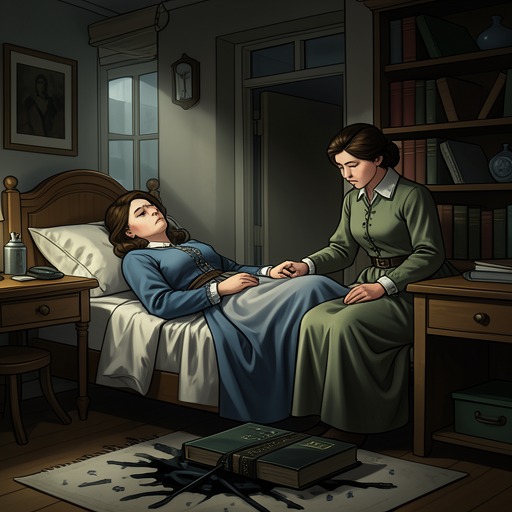
Beth speaks the expression while explaining why she no longer fears death. She tells Jo that she is certain she will remain Jo’s Beth, continuing to love and help her even after death has separated them physically. The statement therefore does not deny loss; it answers loss by claiming that the bond between the sisters exceeds the limits of bodily presence.
The expression appears within a direct appeal to Jo’s future responsibilities. Beth asks Jo to take her place and be everything to their father and mother after Beth is gone, warning her not to fail them. The words join consolation with instruction: Beth reassures Jo that she will not be forgotten, while also asking Jo to transform grief into care for the family.
Love Against Ambition and Possession
Beth contrasts family devotion with Jo’s earlier hopes of writing splendid books and seeing all the world. These desires are not treated as meaningless in themselves, but Beth presents them as unable to accompany a person beyond death. Love possesses a different kind of permanence because it is carried through the lives of those who remain, rather than accumulated as an achievement or possession.
The expression consequently changes the value structure of Jo’s ambitions. Jo has imagined fulfillment through authorship and broad experience, whereas Beth identifies loving service as the form of work that will matter most after the crisis. The contrast is especially powerful because Beth does not argue that Jo has failed; she shows instead that Jo’s deepest inheritance from her sister is a standard by which all other desires can be measured.
Jo’s Response and Ethical Consequence
Jo answers Beth’s teaching with a promise to try. At that moment, she renounces her old ambition and pledges herself to a new one, recognizing what the narration calls the poverty of other desires beside love. The expression thus functions not merely as a memorable saying but as a turning point in Jo’s identity: grief becomes a commitment, and the impending death of a beloved sister becomes the occasion for a new understanding of purpose.
Jo’s response also confirms the reciprocal nature of the expression. Beth’s love does not end with her speech; it acts upon Jo, redirecting her choices. The statement’s meaning is therefore enacted rather than merely explained. Love becomes something that survives by producing responsibility, fidelity, and changed conduct in the person who receives it.
Death, Memory, and Enduring Presence
Beth’s words prepare the narrative for her quiet death. As spring returns and the natural world grows clearer and greener, she is guided tenderly by her parents through the Valley of the Shadow and given up to God. Her death is described without a dramatic farewell: she dies before dawn, on the bosom where she first drew breath, leaving only one loving look and a little sigh.
This restrained ending gives the expression its full force. Beth does not carry worldly accomplishments with her, and the narrative does not make her death a spectacle of extraordinary last words or visions. Instead, the simplicity of her passing places the emphasis on the relationships surrounding her and on the love that remains with Jo and the family. Her final teaching survives because it has entered another person’s life.
Literary and Thematic Significance
The expression condenses the book’s treatment of mortality, family duty, and moral growth into a single principle. It opposes the fear that death makes life empty with the assurance that love gives life continuity. Beth’s belief that love makes the end easier also explains why she can face death without the terror that once held her: she understands herself as continuing through the bonds she has formed.
As a recurring thematic statement, the expression also gives emotional shape to Jo March’s maturation. Jo does not simply lose Beth; she learns to understand loss as a change in the form of their relationship. Beth’s physical life ends, but her love becomes an inward guide for Jo, making the final words both farewell and inheritance. The expression’s lasting significance lies in this transformation of affection into an enduring ethical force.